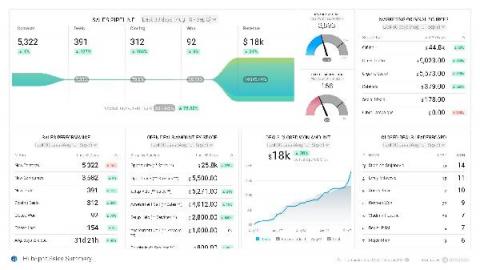
How SMB Owners Build Performance Dashboards With Google Sheets Data
Learn how small business owners can monitor the health of their business at a glance with a minimum of effort.


Let’s face it: In today’s modern world of cloud and containers, there are still thousands of legacy applications that were not written with an API-first approach. Some legacy systems can still provide tremendous value today, but the means for accessing them are completely out of date, thus rendering them almost useless.
There are two types of Ruby Begin and End blocks. A simple Google search of “Ruby begin end blocks” will lead you to either of these two kinds of articles – the ones in all caps (BEGIN and END) and the ones usually separated by a slash (begin/end). Both of these are different things but confused with the same name. In this post, we will dive into both. Here’s an outline of what we’ll be covering so you can easily navigate or skip ahead in the guide –
The RESTful web API has long been the industry standard, but in recent years, APIs based on the GraphQL Schema Definition Language has grown in popularity. This post will go over the advantages and disadvantages of each, as well as when GraphQL makes sense for your application.
Sometimes I walk through the grocery store and marvel at the way customers float through the aisles, blissfully unaware of the logistical nightmare it probably took to stock the shelves. They have no idea how many people, systems, and modes of transportation it takes to make everything magically appear on their grocery shelves. But I do. As the Senior Director of Software Engineering at KlearNow, I spend my days preserving the bliss of those grocery shoppers.
The rise of game engines has sparked new innovations across industries. Amazon Lumberyard — the Amazon game engine — has recently transitioned to open source. Open 3D Engine (O3DE) may be new on the scene. But as companies continue to move to the cloud, many are looking at this new Amazon game engine to transform their pipeline.
Through FMEAs, product development teams are able to determine potential failures within a project and improve them to mitigate risk. The most efficient way to conduct a failure mode and effects analysis is through an automated tool. This blog will provide an overview of FMEAs and highlight the many benefits they can have on your product.
The development of a digital product has been redefined to involve only 4 phases, as TCGen and Product Plan propose: However, having an easier-to-follow process is not the only improvement that you can implement: cost and time efficiency can be taken a huge step further when you incorporate analytics insights. So, with this infographic, we propose some tools that can help you analyze data sets to enrich the phases of each development process.
“As a gamer, I wish for it. But as a developer, I wouldn’t want to be working on backward compatibility. It’s soul-crushing maintenance work, man!” – A developer on our team who shall remain unnamed! Let’s call her Dev-I for now. Last week, I was talking to internal Appian developers on backward compatibility (BC) when one of them shared this quote.
For modern businesses faced with increasing volumes and complexity of data, it’s no longer efficient or feasible to rely on analyzing data in BI dashboards. Traditional dashboards are great at providing business leaders with insights into what’s happened in the past, but what if they need actionable information in real time? What if they want to use their data to estimate what may happen in the future? Companies are taking notice.