Systems | Development | Analytics | API | Testing

Featured Post

DBA, The Key to Improving Security and CX Without Compromise

Today's consumers demand Amazon-like digital banking experiences. However, striking the right balance between customer experience and security remains an arduous challenge for banks. A consequence of user-driven authentication mechanisms is that a better customer experience usually comes at the expense of robust security measures. Contributing to the challenge is the fact that the majority of banks today rely on user-driven customer identity and access management (CIAM) systems. This requires customers to provide information each time verification is needed.

Introducing Choreo Marketplace and Connections

An API-first approach has become a key driver for innovation and agility in modern software development. Through this, businesses can accelerate development cycles, and create powerful, interconnected applications that meet the evolving needs of users and markets. As part of our commitment to empowering enterprises on their API-first journey, our team at Choreo is thrilled to announce the introduction of two new features – Choreo Marketplace and Connections.

Implementing GraphQL Subgraphs with Ballerina Swan Lake for Federated APIs

This article is based on Ballerina Swan Lake Update 7.2. Today, I want to share insights into implementing GraphQL subgraphs in Ballerina. But before we dive into coding, let's take a moment to understand GraphQL federation and the problems it solves. Ballerina Swan Lake WSO2 is an open-source and cloud-native programming language optimized for integration GraphQL Federation is a way to build a unified GraphQL API by combining multiple GraphQL services.

Legacy Code to Cloud Migration with Choreo

In today's evolving technology landscape, businesses are increasingly recognizing the potential of migrating legacy systems to the cloud. Even though they are the backbone of many organizations, legacy systems and services deployed via on-premises servers often need help to keep up with modern business requirements. Cloud migration offers a transformative opportunity to enhance scalability, flexibility, and efficiency, while enabling access to a wealth of innovative services.

How We Implemented Zero Trust in Choreo

In the past, enterprise software focused on protecting network access through on-premises firewalls and VPNs, working on the assumption that everything within the network was secure. However, today, as accessing data has extended beyond on-premises locations to cloud and hybrid networks, SaaS platforms require a security model that can address a broader range of attack vectors. Zero Trust security addresses this pressing need.

Why Building a Platform May Not Be Your Best Bet-Exploring Five Critical Reasons

As the technology landscape continues to rapidly evolve, creating a platform that introduces the correct abstractions for software development and delivery has become an increasingly compelling proposition. But the pivotal question remains: is building what’s known as an internal developer platform (IDP) or digital platform in-house the right move for your organization? The choice isn't merely technical; it's strategic.

Explore the New and Improved WSO2 Micro Integrator Runtime Versioning System With Choreo

Choreo now allows you to specify WSO2’s Micro Integrator runtime version and update level when deploying integrations. Previously, Choreo defaulted all deployments of WSO2 Micro Integrator projects to a specific runtime version and update level. With this improvement, developers can specify the exact runtime version and update level required for their integrations. This improvement simplifies the development and troubleshooting process for integration developers.

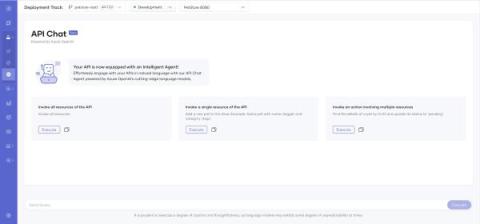
Introducing Choreo API Chat: Transforming Your API Interactions With AI

We're delighted to unveil Choreo API Chat, Choreo's innovative approach to interacting with APIs, powered by Generative Pre-trained Transformer (GPT) 3.5 large language model (LLM) from Azure OpenAI. This allows users to try out APIs running or proxied via Choreo using natural language, serving as a complementary tool to traditional methods. It offers a convenient way to quickly try out endpoints without delving deeply into API specifications or crafting intricate JSON payloads.