New capabilities remove barriers to production-ready AI applications with agent-powered workflows, automated data protection, and private cloud connectivity.
As regulatory frameworks such as the General Data Protection Regulation (GDPR), Digital Operational Resilience Act (DORA), and Network and Information Security Directive 2 (NIS2) converge with the US Clarifying Lawful Overseas Use of Data Act (CLOUD Act), contractual assurances are no longer a sufficient defense. For senior leadership, digital sovereignty has evolved from a compliance checkbox into a core architectural requirement.
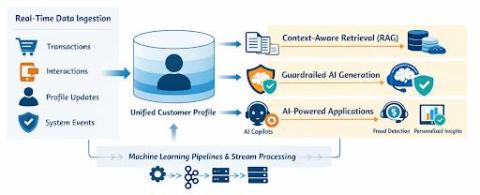
Every customer interaction generates signals that matter—a failed checkout, repeated form errors, a frustrated support call, a confusing AI agent exchange, or an unresolved email thread. Individually, these are isolated events. Connected, they reveal customer intent, friction points, operational risk, and opportunities for action.
Wix rewired 85% of its data volume onto Confluent Freight Clusters—and the result was lower costs and elastic scalability that handles Black Friday–scale spikes without manual intervention. Josef Goldstein explains why it felt like a magical solution.
We’re introducing enhanced visibility for streaming workload performance on Confluent Cloud, making it easier for developers and operators to understand, troubleshoot, and optimize real-time applications. As Apache Kafka has become the backbone of data streaming, many teams rely on Confluent Cloud for its scale, elasticity, and reduced operational burden.
Organizations are under pressure to feed data lakes and lakehouses with fresher data while keeping a tight lid on cloud spend. The problem is that most ingestion stacks weren’t designed for the real-time, high-volume workloads that power modern analytics and artificial intelligence (AI). They rely on layers of connectors, ETL jobs, and maintenance processes that quietly inflate both infrastructure and operational costs. Confluent’s Tableflow was built to change that equation.
Wix processes 40 billion events a day across use cases that range from minutes to milliseconds. Josef Goldstein explains why the entire upstream architecture has to be built around your most latency-sensitive lane—or none of it works.
Real-time data and AI are converging—and companies that have already solved the data pipeline problem are pulling ahead fast. Wix processes over 40 billion interactions every day across hundreds of millions of websites, and the architecture behind that scale didn't happen by accident. It was built, lane by lane, around the principle that your upstream data must be at least as fast as your fastest use case.
Adding large language models (LLMs) and artificial intelligence (AI) to real-time event streams comes down to one thing: picking the right boundary between data transport and model compute. Where you run inference determines your system's resilience, latency, and cost. This article is for data engineers, streaming architects, and developers who want to add AI capabilities to their Apache Kafka event backbone without destabilizing production consumer groups or blowing through API rate limits.
AI has evolved fast. We've gone from static, predictive models to dynamic, interactive agents. But most organizations still run data pipelines that haven't kept up. Consider what’s happening in modern AI architecture. Teams deploy high-performance engines like large language models (LLMs) and real-time fraud detectors, then feed them data that's hours or days old.
KCP automatically generates custom Terraform modules, allowing you to provision your entire target infrastructure and networking in just a few minutes for Kafka migrations.