Systems | Development | Analytics | API | Testing

Why AI Sovereignty Is an Operational Problem

AI sovereignty has become one of those phrases that sounds precise until someone asks what it actually means. For one federal agency, sovereignty means keeping sensitive data inside accredited boundaries. For another, it means running open-weight models in a FedRAMP-authorized private cloud. In defense and intelligence settings, it may mean operating inside an air-gapped environment at IL5 or IL6.

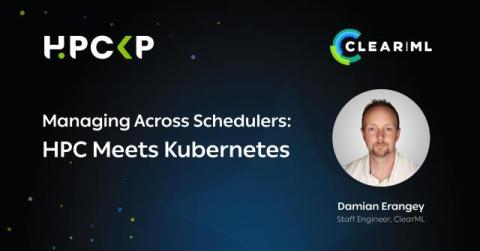
Managing Across Schedulers: HPC Meets Kubernetes

Almost every infrastructure team running modern AI is wrestling with the same question. The orchestrator their AI workloads want, Kubernetes, and the orchestrator their HPC environment was built on, Slurm, pull in different directions. This piece, drawn from the HPCKP 2026 session of the same name, looks at why that tension exists, what the workloads actually look like, how teams are bridging the two today, and where the pattern is heading.

Automating the Embodied AI Pipeline: A ClearML and Dell Robotics Proof of Concept

Training models for physical robots is harder than training a typical model. The data has to be collected by hand through teleoperation, every change has to be tested on real hardware, and the loop from data to deployment runs constantly. In a recent proof of concept with a Singapore government agency, ClearML, Dell Technologies, and Hugging Face’s LeRobot framework turned that high-touch, manual process into an automated pipeline.

Inference Is the New Bottleneck: How to Plan GPU Capacity for Production AI

Most enterprises sized their AI infrastructure with a playbook written for training. However, training is no longer the typical workload. Inference now eats up roughly two-thirds of all AI compute, and it is changing shape fast enough that the rules of thumb from 18 months ago just do not hold. Our view at ClearML is pretty simple: when the workload shifts this much, the platform underneath it has to shift with it.

Pre-Packaged Inference, Production-Grade: AMD AIMs with ClearML

Running production LLM inference on a new accelerator family is a layered problem. The model matters. The runtime that exists for the GPU you have matters at least as much. So does the precision mode that works without losing accuracy, the inference engine that hits your throughput targets, and the secure endpoint the rest of your stack can actually call. The entire stack underneath the model is where most of the real engineering work lives and where the cost of getting it wrong shows up first.

Inside NERSC at Berkeley Lab: How a DOE Office of Science User Facility Is Exploring ClearML for Scientific AI Workflows

NERSC, the mission high-performance computing center for the U.S. Department of Energy Office of Science, is using ClearML as part of the AI infrastructure stack for Perlmutter, the upcoming Doudna supercomputer, and the broader American Science Cloud. Here is a look at what they are exploring and why it matters for AI for science at scale.

ClearML and Dell Technologies: A Faster Path to Enterprise AI

Enterprises are buying AI infrastructure faster than their platform teams can operationalize it. Dell and ClearML are working together to close that gap, giving enterprises a faster, simpler path from Dell AI Factory hardware to a production-grade AI platform. Dell carries the hardware. ClearML provides the AI infrastructure layer on top. Together, the two give platform teams a way to deliver AI as a service to their organization without a multi-year integration project.

When AI Infrastructure Meets Enterprise Data: ClearML on the Dell AI Data Platform

Dell Technologies has published a validated integration of ClearML with the Dell AI Data Platform (AIDP), pairing ClearML’s AI infrastructure capabilities with Dell’s enterprise-managed storage and search engines. The result is a reference architecture that lets AI teams keep moving fast while platform teams keep the data foundation enterprise-grade. Here is what the integration does, why it matters, and where it fits.

Enterprise AI Security with ClearML: A Complete Series Summary

Over a seven-part series of posts and videos, ClearML’s Enterprise AI Security series covered every layer of securing an AI platform in production, from who gets in to what gets recorded. This post brings it all together in one place: what each layer does, why it matters, and how the layers connect.

ClearML Joins the Dell AI Ecosystem Program and Launches AI Factory Blueprints, Making It Easier for Enterprises to Operationalize AI

ClearML is deepening its partnership with Dell Technologies by joining the Dell AI Ecosystem Program, announced at Dell Technologies World 2026. As part of this collaboration, ClearML is launching two pre-validated deployment blueprints — for Kubernetes and OpenShift — available in the Dell Automation Platform catalog, giving enterprises a fast path from bare metal to a full AI stack.