
Top Automated Testing Platforms for AI-Driven Software Development

Image Source: depositphotos.com
AI-driven software development has reshaped what QA teams face daily. Codebases evolve faster, release cycles are shorter, and a single missed regression can hit production within hours. Today's top automated testing platforms have moved well past scripted checks, they now use machine learning to write, maintain, and adapt tests on their own. The five platforms below represent where the market stands in 2026, chosen for their AI architecture, enterprise track record, and real documented results.
1. Functionize
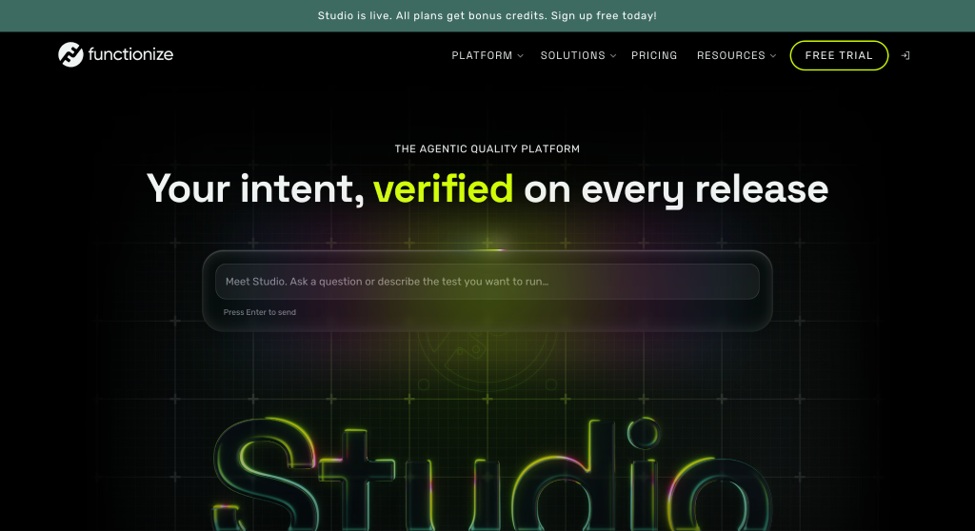
Teams that want AI to carry the maintenance burden, not just accelerate recording, tend to land on Functionize early. What distinguishes the platform is that automated testing by Functionize runs on specialized agents that observe application behavior, generate tests, and self-heal when the UI changes, rather than relying on brittle locators that break with each release cycle.
Founded in 2014 and based in Walnut Creek, California, the platform draws on eight years of enterprise training and more than 30,000 data points per page to power element recognition that hits 99.97% accuracy. That figure translates directly into an 80% reduction in flaky tests and maintenance overhead. Non-technical staff can stand up tests in seconds, roughly 90% faster than traditional scripting.
Client results put concrete shape to those numbers. GE Healthcare cut 40 hours of testing time down to 4 hours, a 90% labor reduction. McAfee compressed testing from hours to minutes while expanding coverage across global markets. Functionize holds over 60 enterprise clients, including Fortune 500 companies, and was named a Strong Performer in the Forrester Q4 2025 Wave Report on Autonomous Testing Platforms.
2. UiPath
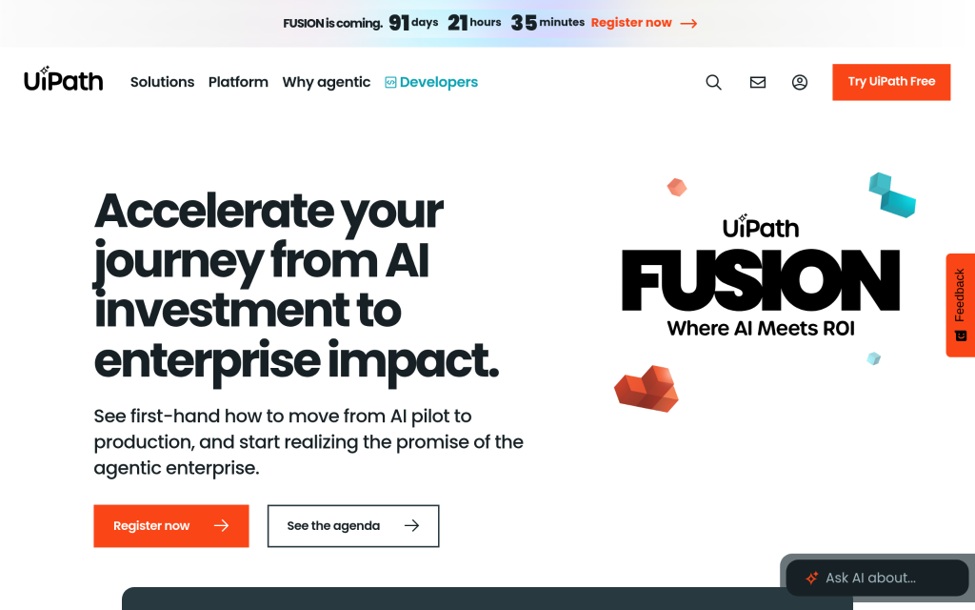
UiPath started as an RPA company in Bucharest in 2005 and has since grown into a full agentic automation platform with around 5,100 employees worldwide. Its testing story lives inside a broader product called UiPath Test Cloud, which handles QA alongside the company's flagship process orchestration and AI agent capabilities. For organizations already running UiPath for workflow automation, adding test coverage through the same platform cuts toolchain overhead considerably.
The platform covers the full enterprise stack - financial services, healthcare, manufacturing, retail, and public sector - and Gartner named UiPath a Leader in the 2025 Magic Quadrant for Robotic Process Automation. Published case studies show the U.S. Department of Veterans Affairs reducing claims processing from 27 days to 12 hours, and WEX saving $2.7 million through automation. Teams whose main need is test-specific AI rather than a combined RPA and testing suite may find the testing module less central to the platform's broader automation focus.
3. Virtuoso QA
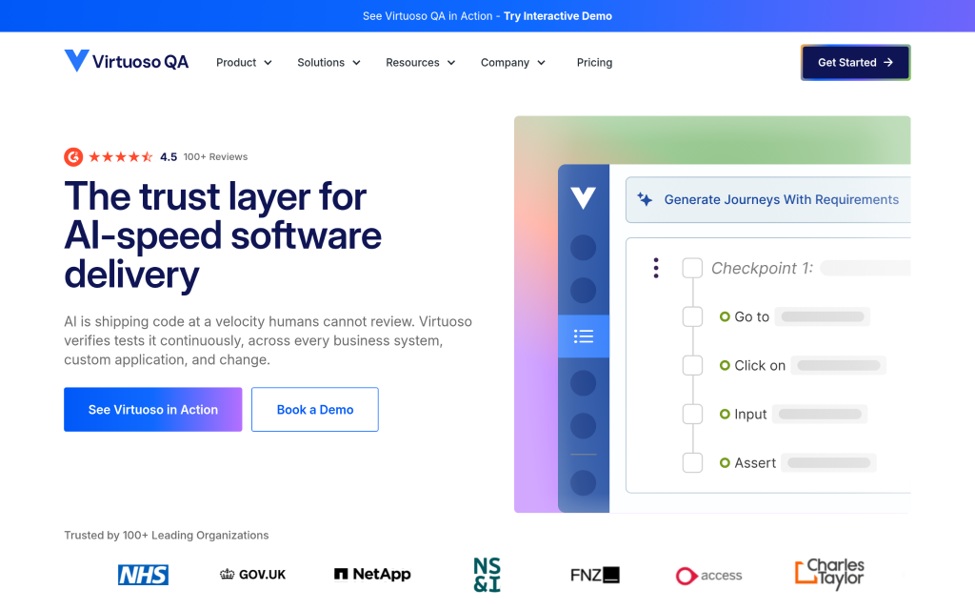
Virtuoso QA launched in 2017 and is headquartered in London. It was built AI-native from day one; machine learning and natural language processing are architectural decisions, not features bolted onto a legacy framework. That distinction matters. Self-healing tests and intelligent regression analysis behave differently when AI is foundational rather than grafted on afterward.
The platform covers web testing across browsers and devices, API testing, composable test authoring in natural language, agentic testing, and root-cause analysis for regression failures. A low-code and no-code authoring model lets QA engineers and business analysts contribute tests without any scripting knowledge. At 112 employees, Virtuoso QA operates at a smaller scale than some rivals, which can mean closer support relationships for enterprise customers, but also narrower ecosystem integrations compared with larger platforms.
4. Diffblue
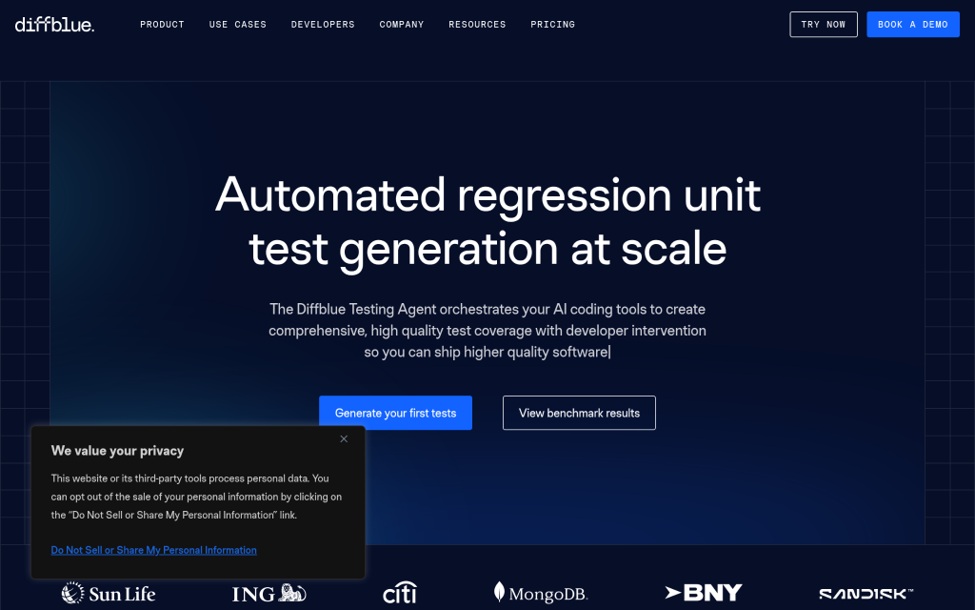
Diffblue spun out of the University of Oxford in 2016 and focuses entirely on one problem: autonomous unit test generation for Java and Kotlin. Its flagship product, Diffblue Cover, is the only fully autonomous AI solution writing unit tests at scale for those languages. The newer Diffblue Testing Agent goes further, building entire test suites at 250 times the speed of a human developer and integrating with enterprise AI coding environments including GitHub Copilot Enterprise and Claude Code.
The technology is grounded in reinforcement learning research from Oxford, and the founders received the Rance Cleaveland Test-of-Time Tool Award for related formal verification work. Diffblue also received a £1 million grant from Innovate UK. Clients include Citi, Cisco, AstraZeneca, ING, and BNY. Its scope is deliberately narrow - Java and Kotlin unit tests only - so teams working across polyglot codebases or needing UI and API coverage will need complementary tools alongside it.
5. Applitools
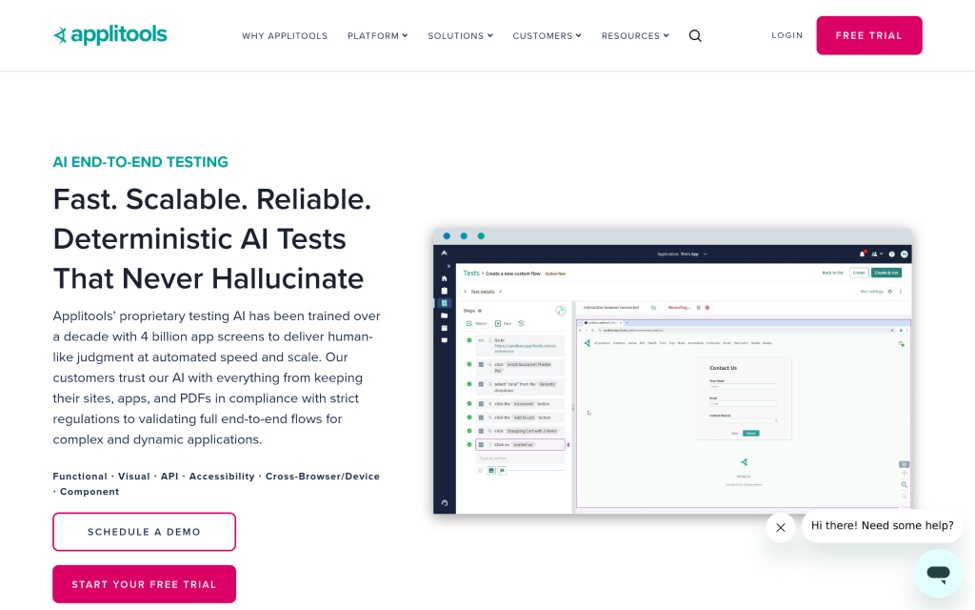
Applitools was founded in 2013 and is headquartered in Tel Aviv, with U.S. operations supporting its American client base. Its Intelligent Testing Platform splits into two products: Applitools Eyes for visual AI testing, and Applitools Autonomous for AI-augmented test creation and execution through recording and natural language authoring. The company's main differentiator is its Visual AI engine, trained over a decade on 4 billion app screens.
That training depth gives the platform a calibrated sense of what a meaningful visual regression looks like versus an irrelevant pixel shift, a distinction that cuts false positives significantly. Coverage spans web apps, native mobile apps, PDFs, components, and cross-browser and cross-device scenarios. Accessibility testing is built in. Applitools offers a tiered pricing model with a fully featured 14-day free trial, which gives smaller teams a low-friction entry point before committing to a subscription.
Bottom Line
These top automated testing platforms don't share a single profile, and the right pick depends on what your team actually needs. Teams running polyglot codebases with heavy UI testing requirements will find broad AI-native self-healing coverage the most practical fit. Organizations already invested in RPA and process orchestration are better served by a platform that folds test coverage into that same toolchain. Enterprises committed to an AI-native QA approach from the ground up should look at platforms where machine learning is an architectural decision rather than a bolt-on. Java and Kotlin shops that need autonomous unit test coverage fast have a narrower but purpose-built category to draw from. And teams where visual quality and cross-browser fidelity carry the most risk should prioritize a platform with a mature Visual AI engine. Matching platform to actual engineering context - language stack, team composition, release cadence - is where the real selection work happens.