We’re in the defining decade of data. Data underpins the technologies transforming how we work, communicate, socialize and buy. If you want to take part in the revolution, you need to become—or hire—a data leader. But what does that even mean? What sets data leaders apart from the average data-aware professional? And how can we become data leaders?
The FIFA World Cup 2022 is nearing its end, and the final game promises to be a nail biter. What started with 32 countries battling it out for close to a month, will now culminate in a play-off between Argentina and France. FIFA projects more than 5 billion people to tune in for the tournament, perhaps making the World Cup Final 2022 the most watched event of the year!
Late last June, I had the opportunity to attend a ThoughtSpot User Group session in London and share how ThoughtSpot has impacted global procurement at Roche—notably how it’s helped my team not become a dashboard factory for the rest of our business.
When setting up a modern data stack, data warehouse modeling is often the very first step. It is important to create an architecture that supports the data models that you wish to build. I often see people going straight to writing complex transformations before thinking about how they want to organize the databases, schemas, and tables within their warehouse. To succeed, it is key to design your data warehouse with your models in mind before starting the modeling process.
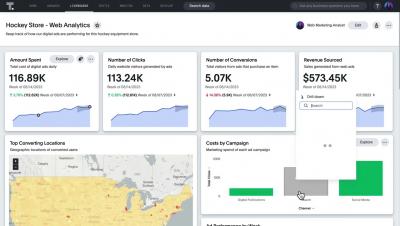
Business monitoring is essential to a company’s success. Whether you’re improving efficiency, saving costs, planning inventory, or tracking goals, you need to define metrics and monitor them regularly to make progress. With ThoughtSpot, business monitoring is an intuitive experience that starts with visualizing your KPIs in real-time so you can take action when there’s movement.
In 1987, economist Robert Solow declared, “You can see the computer age everywhere but in the productivity statistics.” He noted that despite massive investments in computer hardware and software, companies saw a decrease in fundamental productivity measures.