We collect the latest Development, Anaytics, API & Testing news from around the globe and deliver it direct to your inbox. One email per week, no spam.
AI agents can work in the background on your behalf, but, how do you keep them from doing too much? WSO2 Identity Server 7.3 now supports Client-Initiated Backchannel Authentication (CIBA), giving ambient agents access only when the user approves each request through a push notification. The agent can act, but you stay in control.
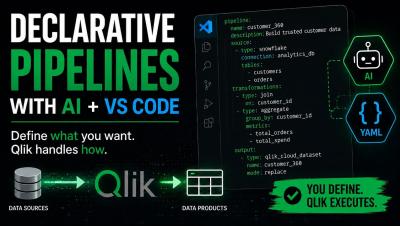
Managing your data pipelines shouldn't mean leaving the tools you already work in. In this video, Qlik Solution Architect, Joe Easley, shows how Qlik's declarative pipelines let you build and manage your integration ecosystem right alongside your own LLM and IDE — no switching platforms, no extra UI to learn. The benefit: faster iteration, fewer handoffs, and pipelines that live where your code already does.
For decades, APIs have been the universal handshake of the digital economy. You want data? Call an endpoint. You want to trigger an action? POST a payload. APIs are simple, predictable, and everywhere. But in 2024, Anthropic introduced the Model Context Protocol (MCP), an open standard that dramatically changed how systems speak to one another. MCP enables AI agents to connect with external apps without custom code.
In a world where knowledge, experience, and even intelligence are no longer barriers, what actually separates the people who thrive from everyone else? In this conversation, we get into the two traits that matter more — curiosity and agency, and why they're becoming the real differentiators in the age of AI. "Today it's Models Day. Tomorrow it may be something else." The tools keep changing; the will to figure things out doesn't.
Two engineers used AI coding agents to design, build, and ship a production-ready status page — here's what worked, what didn't, and what we'd do differently.
Your data pipeline breaks at 2 AM. Again. By morning, corrupted data has cascaded through dashboards, reports sit empty, and your team spends half the day tracking down root causes instead of building features. This scenario plays out across organizations daily. Data engineers spend 44% of their time firefighting pipeline failures rather than delivering value.
AI is writing more of your codebase every quarter. A new Sauce Labs report surveying 400 U.S. executives and engineering leaders shows most organizations still can't verify it's safe to ship, and the incidents are piling up.
Most enterprise AI projects stall when teams try to move experiments into production—where costs, governance, data security, and scale all get real. In this demo, see how Cloudera AI Inference helps turn foundation models into secure, governed, production-ready AI services. You’ll learn how to: Chapters: Subscribe to stay ahead of the curve with the latest in data strategy, open architectures, and enterprise AI innovations.