We collect the latest Development, Anaytics, API & Testing news from around the globe and deliver it direct to your inbox. One email per week, no spam.
Following your migration assessment, it is time to execute the transfer of your data and SQL queries into Google Cloud. This video dives into the specific tools and services that simplify migrating workloads from Snowflake, Teradata, Cloudera, and Databricks into BigQuery, Dataproc, and Google Cloud Storage.
Many AI analytics platforms force enterprises into an impossible choice: adopt cloud-only solutions that compromise data governance and security policies or forgo AI capabilities entirely. But there’s a significant problem with that: most companies aren’t 100% cloud-based, and those that are vary between whether they operate in the public cloud, private cloud, or a hybrid environment.
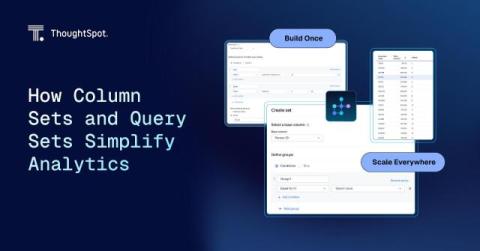
When you’re building analytics for users, you quickly realize something: not every definition belongs on the Model. A lot of business logic sits in an awkward middle ground, too context-specific to hardcode into the Model but too important to leave scattered across one-off formulas. And in most tools, if the logic doesn’t live on the Model, every team ends up rebuilding the same thing over and over again. That’s where Query Sets and Column Sets in ThoughtSpot come in.
Healthcare organizations can’t achieve true Patient 360 or power accurate AI and analytics when identity data is fragmented across EHRs, EMRs, CRMs, and countless clinical and operational systems. Check out the full video to see how Verato MDM Cloud delivers industry-leading healthcare identity resolution and master data management (MDM) directly inside Snowflake to unify, enrich, and master patient and provider data with unmatched accuracy.
Stop manually juggling mismatched data formats! This video demonstrates how to join Parquet and JSON files directly within ThoughtSpot Analyst Studio’s Python Notebook to create a single, enriched dataset. What you will see: This is a must-watch for data professionals looking to unify complex, multi-format data sources and deliver searchable, AI-ready insights in one continuous workflow.
Apache HBase provides a distributed, column-oriented model with tables → rows → column families/qualifiers and versioned cells. The design is ideal for sparse, wide datasets. ETL is central because performance hinges on how data moves through the default write path—WAL → MemStore → HFiles—versus bulk-load paths that write HFiles directly.
People feel more confident when their decisions are backed by numbers. That’s just human nature. Add a chart or a metric to a conversation, and suddenly an opinion feels more credible. This is one reason companies invest heavily in analytics tools. They’re not just buying dashboards, they’re buying confidence. Confidence that decisions are grounded in reality, not gut feel. But here’s the problem: having data doesn’t automatically make decisions easier.