Systems | Development | Analytics | API | Testing

How to Improve Customer Experience with AI: 3 Strategies for Success

In today's hyperconnected world, where negative reviews on social media can wreak havoc on a company’s reputation, delivering an exceptional customer experience isn't just a luxury—it's a business imperative. Companies are locked in a fierce battle for customers that is primarily based on their ability to deliver outstanding customer experiences (CX). According to research by The Conference Board, 65% of CEOs globally prioritize investing in strategies to improve CX.

Star Schema Vs. Snowflake Schema: 4 Key Differences

Organizations rely on high-performance data warehouses for storing and analyzing large amounts of data. An important decision in setting up a data warehouse is the choice between Star Schema vs. Snowflake Schema. The star schema simplifies the structure of a database by directly connecting dimension tables to a central fact table. The star shaped design streamlines data retrieval and analysis by consolidating related data points, thereby enhancing the efficiency and clarity of database queries.

BigQuery vs. Redshift: Which One Should You Choose?

Considering BigQuery vs. Redshift for your data warehousing needs? This guide is for you. Both BigQuery and Redshift stand as leading cloud data warehouse solutions each offering a multitude of features catering to multiple use cases. Google’s BigQuery offers seamless scalability and performance within its cloud platform, while Amazon’s Redshift provides great parallel processing and tuning options.

How to Load Data from AWS S3 to Snowflake

According to a study by Statista, the cloud storage market was valued at $90.17 billion in 2022 and will reach a value of $472.47 billion by 2030. These figures indicate a growing shift toward cloud computing and data storage solutions. A typical scenario in modern data management involves data transfer from cloud storage to cloud-based computing platforms. Amazon’s Simple Storage Service (S3) is among the go-to options for the former, and businesses trust Snowflake for the latter.

Business Process Improvement: How to Get Started

Business process management solutions often tout their analysis and optimization capabilities, but few provide the full set of tools needed to build a process, measure its performance, and identify and implement improvements. And when you’re looking for information on how to optimize a process, it’s easy to quickly get lost in the information-overload about the best methodologies and tools. That’s likely because the answer to process improvement isn’t straightforward.

3 Examples of Intelligent Automation in Insurance

Intelligent automation happens when robotic process automation (RPA) meets artificial intelligence (AI), bringing simple actions and cognitive tasks together for lightning-fast processing. Intelligent automation in insurance is a powerful tool that reduces both human error and the need to perform repetitive tasks manually. Imagine AI extracting data from an invoice then a bot entering that data into a software program.

Data Integration in the Life Sciences: Eliminate Data Silos for Good

In the life sciences industry, where breakthroughs in research and healthcare are fueled by data, data silos can be a big problem. Data silos might be caused by things like legacy systems, departmental divisions, disparate data formats, or lack of interoperability standards. Data silos can manifest at any point in the product lifecycle and make it hard for the right people to access and use the information they need, when they need it.

What Is Data Governance and Why It Matters?

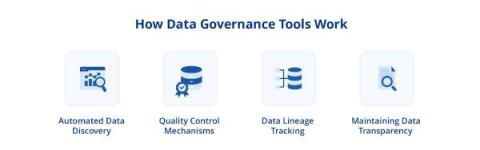
Data governance refers to the strategic management of data within an organization. It involves developing and enforcing policies, procedures, and standards to ensure data is consistently available, accurate, secure, and compliant throughout its lifecycle. At its core, data governance aims to answer questions such as.

What Can AI Do for Business? 5 AI-Centric Benefits

In just a few months, enterprise AI has rapidly evolved into a strategic partner for organizations that want to stay ahead of the disruption curve. Whether enterprises are leveraging predictive analytics for strategic decision-making, using machine learning algorithms for supply chain optimization, or applying generative AI and large language models to enhance customer service, it’s clear AI will help business in many ways.