From Dashboards to Decision Flows: Embedded Analytics That Trigger Action

Teams have more dashboards than ever. They also have more dashboard fatigue. Metrics are easy to display. Decisions are harder. A chart can show a drop in revenue, but it rarely tells a product leader what to do next. That gap is why many teams stay stuck in review mode instead of action mode. This is where decision-centric analytics changes the pattern. The goal is not more visibility. The goal is faster recognition, better understanding, and clear follow-through when something changes.

Conversational Analytics in 2026: Where Natural Language Search Helps

In 2026, asking a BI tool, “What happened to revenue last quarter?” feels almost effortless. That ease is the appeal of conversational analytics. It turns plain language into charts, metrics, and short explanations. It sits inside the broader world of augmented analytics, where AI helps people ask better questions and move faster. But speed can hide problems. If the metric is vague, the calendar is wrong, or access rules are loose, a fast answer can still be the wrong answer.

Why Trusted Data Is the New AI Moat (w+ Rick Kranz from the AI Marketing AUtomation Lab)

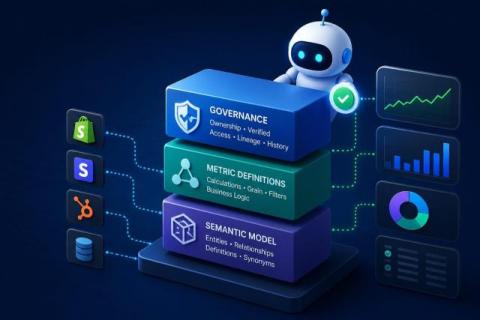
Rick Kranz has built over 100 AI automations for his community and clients — he has no reason to defend Databox. But when he tried to run his AI analysis without the Databox MCP, it just stopped working. In this episode, Rick and Pete break down exactly why: the semantic layer, the metric definitions, and the standardized math that make an AI's answer trustworthy instead of a guess. If you've ever wondered why connecting five random MCP servers to Claude doesn't give you the same results as a purpose-built data layer, this is the episode.

Advancing ThoughtSpot's Commitment to Apache Ossie (Incubating), the Next Chapter of OSI

When the Open Semantic Interchange (OSI) initiative launched last year, it set out to solve a problem every data leader recognizes: the same business metric gets defined a dozen different ways across a company's BI tools, warehouses, and now, AI agents. "Monthly active users" in the CRM rarely matches "monthly active users" in the warehouse, and every new AI copilot added to the stack makes the gap more visible, not less. That initiative has just taken its most consequential step yet.

Ep 80 | Decision Logic: The Difference Between an Answer and a Decision

Ask an AI system a question, and you'll get an answer. Decision logic determines whether you should trust it. In this episode of The AI Forecast, Paul Muller sits down with Darlene Newman, Innovation Lead at Duczer East, to explore the hidden layer that helps AI move from pattern matching to practical decision-making.

Is Your AI Startup CEO Lost in the Plot? #Shorts #podcast #cloudsecuritypodcast

Drawing on his experience at Google, Google X, and as the CEO and co-founder of an AI startup, Varun Puri shares practical lessons on embedding AI into everyday workflows and building habits that stick. Discover how to maintain perspective on what is working, even when AI constantly highlights what isn’t.

The Missing Piece of Your AI Strategy: Data at the Edge

Companies everywhere are rushing to deploy AI models to outpace the competition, but they are running headfirst into a brutal reality check: an AI model is only as brilliant as the data feeding it, and most data simply isn't AI-ready. The high-value, real-time data required to power these models doesn’t live in a pristine, pre-formatted cloud data warehouse. It is generated in the physical world on factory floors, inside hospital rooms, and at point-of-sale terminals.

Beyond Static KPIs: Leveraging Augmented Analytics for Predictive Business Growth

In volatile markets, a KPI dashboard that only tells you what happened last week is already too late to guide confident action. Many companies have dashboards. Fewer have KPI systems that help them spot revenue shifts, retention risk, margin pressure, or supply-chain trouble before those issues hit the business hard. That gap is where augmented analytics comes in.

Top 10 Reasons to Invest in Product Experience Management (PXM) Software

Implementing a PXM solution provides numerous benefits to your organization, from improving efficiency to increasing sales, reducing returns, and promoting customer loyalty. Today, we’re going to explore these benefits in more detail. Interested in the distinctions between PIM and PXM? See our breakdown of how they differ (but are also similar) here.