We collect the latest Development, Anaytics, API & Testing news from around the globe and deliver it direct to your inbox. One email per week, no spam.
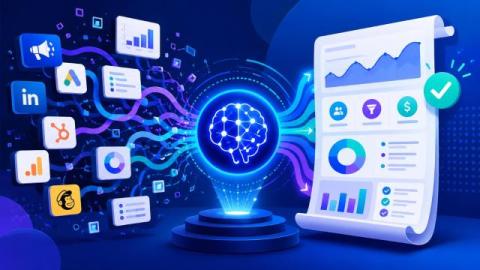
A six-step AI diagnostic workflow with copy-paste prompts to find out exactly what broke in your B2B funnel, and whether the problem is even where you think it is.
A marketing director sits down ten days after her campaign closed. Six browser tabs are open: LinkedIn Ads, HubSpot, GA4, Mailchimp, an attribution spreadsheet, and a blank doc that is supposed to become the post-mortem narrative. The meeting is in two hours. She knows something broke in the middle of the funnel (pipeline came in below target), but she cannot prove where or why until she reconciles numbers across all six sources.
There's a pattern we see repeatedly in enterprise AI projects. A team identifies a compelling use case. They build the model. They staff the project. Then they spend the next six to eighteen months trying to solve a problem that was never on the roadmap: their data isn't ready. Not because it doesn't exist. It exists everywhere: in cloud warehouses, on-premises databases, SaaS platforms, and data lakes across multiple regions.
AI is reshaping many industries and tools at breakneck speed. Business Intelligence is no exception, but things might not end up in a way you might expect. There’s still hope for BI and vendors that manage to embrace, rather than try to fight the AI tsunami. You are an executive looking for answers. Before, in order to get them you had to reach out to your analysts, or external agencies, or try to make sense of broken dashboards set by people who have left the company years ago.
This has been the reality of clinical decision-making for years: healthcare reacts after the signal becomes visible. Traditional clinical decision support systems helped standardize care and reduce errors, but most systems relied on static rules and issued alerts only after an event had occurred. They identify danger when it is already happening, not when it is quietly forming underneath the surface. That delay is expensive clinically, operationally, and financially.
Enterprises are buying AI infrastructure faster than their platform teams can operationalize it. Dell and ClearML are working together to close that gap, giving enterprises a faster, simpler path from Dell AI Factory hardware to a production-grade AI platform. Dell carries the hardware. ClearML provides the AI infrastructure layer on top. Together, the two give platform teams a way to deliver AI as a service to their organization without a multi-year integration project.
Meetup Date - 30th May 2026 10:30AM to 2PM Where - Cloudera Bangalore Office Subscribe to stay ahead of the curve with the latest in data strategy, open architectures, and enterprise AI innovations.
Today we're releasing v26.1.0 of the Countly SDK for HarmonyOS — our first official SDK for Huawei's operating system, now available on GitHub. For most product teams outside Asia, HarmonyOS has been easy to overlook. That's no longer the case.
AI governance is already struggling to keep pace. Add quantum computing and space infrastructure, and the challenge becomes exponentially harder. In this episode of The AI Forecast, Paul Muller sits down with technology governance specialist and researcher Preetha Bedi to explore the growing convergence between AI, space, and quantum technologies—and why this nexus is creating entirely new categories of systemic risk.