95% of AI projects fail. Is your "tech-first" mindset to blame? @wharton’s Stefano Puntoni breaks down the Human-AI gap with podcast host Cindi Howson on.
AI isn't failing because the models are weak. It's failing because the data beneath them is broken. 88% of AI pilots never make it to production. 74% of companies haven't seen value from AI. The uncomfortable truth? These failures aren't about intelligence—they're about access, governance, and context.
Learn why scaling AI is as much a human challenge as it is a technological one. Stefano Puntoni, Co-Director of Wharton Human-AI Research and Professor at The Wharton School, examines the limits of data-driven decision making in the age of AI and why insights so often fail to translate into action. He breaks down the psychology behind AI resistance and outlines the leadership and change management strategies needed to turn AI potential into real organizational impact.
Is AI a tool or a threat? Wharton Professor Stefano Puntoni explains why "self-preservation mode" is killing AI adoption in the workplace. Puntoni joins Cindi Howson (The Data Chief host) & breaks down why AI isn't a strategy—it's a tool that requires a "meet in the middle" approach. To succeed, leaders must provide the vision and resources, while empowering workers to co-create the roadmap.
From econometrics to anthropology to leading roles at Salesforce, AWS, and Nextdoor, Tatyana shares how her background shaped a fundamentally different approach to leadership. Drawing on her unconventional journey, she explains why agentic AI is forcing leaders to rethink how they manage technology, shifting from systems to a focus on teams, culture, and governance. Together, Tatyana and Paul share their perspectives on.
In an always-on industrial economy, fragmented data is a liability. Your analytics reports may look flawless, but if they’re built on data silos scattered across edge, core, and cloud, they’re built on a fault line. Data silos drive-up costs, distort the critical decisions meant to drive competition, and prevent organizations from reaching a state of data singularity — where data becomes unified, portable, and continuously usable for AI.
Modern enterprises are currently overwhelmed by massive, fast-moving data in various formats that traditional legacy warehouses simply cannot manage. Cloudera addresses these complexities with its open data lakehouse powered by Apache Iceberg, providing a single, seamless, and optimized view of all your information.
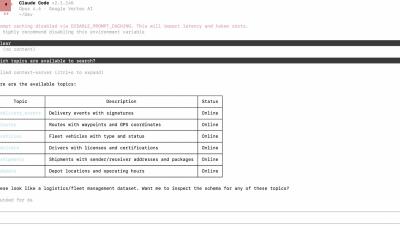
Most agencies report on growth. But growth alone doesn’t answer the real question clients care about: Are we actually competitive? In this walkthrough, 42 Agency shows how they use the Databox MCP with Claude to benchmark client performance against relevant peer groups — filtered by size, revenue, and industry. Instead of relying on generic industry averages, they combine: The result? Stronger strategy conversations, clearer goal setting, and more confident planning grounded in a real market context.–
If you’re consistently posting on LinkedIn, the hard part isn’t getting data — it’s analyzing it. Most people review posts one by one, compare impressions manually, and try to “spot patterns” by eye. That’s slow. And it makes strategy reactive. In this walkthrough, Kamil Rextin, founder of 42 Agency, uses the Databox MCP with Claude to run a fast, AI-driven analysis of his LinkedIn performance — the kind of first-pass review you’d normally assign to a junior analyst.
This is a Data App that collects structured product submissions from a team, validates them, queues them for approval, and writes approved entries directly to a Keboola table. I built it with Kai in one conversation. No Google Sheets. No broken column headers. No emailing CSVs. If you've ever needed your team to submit structured data - new products, budget inputs, campaign briefs, vendor details - and the spreadsheet approach keeps falling apart, keep reading.