It’s no secret that modern data professionals are under immense pressure to deliver more data and insights to more business users, more quickly than ever before. Data is the lifeblood of your business. And frontline business people need personalized, actionable insights to make data-driven decisions. But before these users even touch a self-service Live Analytics platform like ThoughtSpot, the data must be appropriately modeled by analytics engineers.
As companies go all in on the cloud to dominate the decade of data, agility, flexibility, and ease of use are critical to success. That’s why we’re so excited to announce ThoughtSpot’s support for Amazon Redshift Serverless which allows customers to leverage the Modern Analytics Cloud to run and scale analytics on Amazon Redshift without having to provision and manage any data warehouse infrastructure.
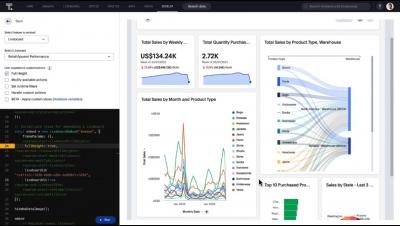
Today, we are excited to announce the availability of CodeSpot, a searchable repository of ThoughtSpot blocks and code samples to help developers embed engaging analytics experiences into any app for the modern data stack. CodeSpot harnesses the knowledge and experience of ThoughtSpot Everywhere developers, data analysts and engineers, and product experts to build a broad ecosystem of shareable assets to accelerate development projects and benefit our developer community and customers.
Wondering how to add custom HTML styling to your chart headers and descriptions, or add conditional formatting to your KPI charts? See how in ThoughtSpot's 8.2.0.cl release!
To learn more, please visit https://www.thoughtspot.com/new-features/8.2.0-cloud
ThoughtSpot elements such as search, Liveboards, and data connections are all defined in a JSON-based metadata definition called ThoughtSpot Modeling Language, or TML. Recently, I blogged about how you can use Postman to access platform APIs to import/export TML as part of your devops processes; for example, to check in TML definitions and push to another environment via a continuous integration process. The TML export is pretty straightforward.
When I was working at Google back in the mid 2000’s, we dealt with tens of billions of ad impressions a day, trained several machine learning models on years worth of historic data, and used frequently-updated models in ranking ads. The whole system was an amazing feat of engineering and there was no system out there that was even close to handling this much data. It took us years and hundreds of engineers to make this happen, today, the same scale can be achieved in any enterprise.
We’re entering the defining decade of data. While every aspect of our lives have been changed by data in recent years, the next ten will see data rebuild the world around us. Every business, in every industry, needs a plan to adapt to this new world if they want to thrive. But how? That’s a question in the minds of data leaders, CEOs, and board members. The right approach is critical if companies want to dominate this new era. The wrong decision can spell disaster.