Systems | Development | Analytics | API | Testing

How to Build a Smart GenAI Call Center App

Building a smart call center app based on generative AI is a promising solution for improving the customer experience and call center efficiency. But developing this app requires overcoming challenges like scalability, costs and audio quality. By building and orchestrating an ML pipeline with MLRun, which includes steps like transcription, masking PII and analysis, data science teams can use LLMs to analyze audio calls from their call centers. In this blog post, we explain how.

Transforming analytics on the cloud: Supercharge your data applications

Transforming analytics on the cloud: Supercharge your data applications with Databricks, AWS and Unravel Organizations are feeling pressure to launch new data applications faster to meet end-user demand. Cloud data platforms help accelerate launch times with on-demand delivery of infrastructure and pay-as-you-go pricing. Last year, 98% of the overall database management system (DBMS) market growth came from cloud database platform as a service (dbPaaS). 80% of organizations have adopted agile practices to increase their pace of innovation.

Leveraging Kotlin Collections in Android Development

Kotlin has gradually replaced Java as the lingua franca of Android programming. It’s a more concise language than Java, meaning your code works harder and you can build leaner applications. And Kotlin Collections are fundamental. These collections play a fundamental role in our work as programmers by simplifying the organization and management of data. Whether it’s a list, set, map or other data structure, they allow us to categorize and store data logically.

Cloudera Operational Database (COD) Performance Benchmarking: Comparing HDFS and Cloud Storage

Have you ever wondered how massive business and consumer apps handle that kind of scale with concurrent users? To deploy high-performance applications at scale, a rugged operational database is essential. Cloudera Operational Database (COD) is a high-performance and highly scalable operational database designed for powering the biggest data applications on the planet at any scale.

Build Streaming Apps Quickly with Flink SQL Workspaces

At this year’s Current, we introduced the public preview of our serverless Apache Flink® service, making it easier than ever to take advantage of stream processing without the complexities of infrastructure management. This first iteration of the service offers the Flink SQL API, which adheres to the ANSI standard and enables any user familiar with SQL to use Flink.

Six Key Predictions for Artificial Intelligence in the Enterprise

As we head into 2024, AI continues to evolve at breakneck speed. The adoption of AI in large organizations is no longer a matter of “if,” but “how fast.” Companies have realized that harnessing the power of AI is not only a competitive advantage but also a necessity for staying relevant in today’s dynamic market. In this blog post, we’ll look at AI within the enterprise and outline six key predictions for the coming year.

Branch by Abstraction | Microservices 101

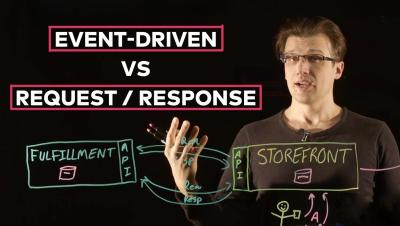
The Branch by Abstraction Pattern is a method of trunk-based development. Rather than modifying the code in a separate branch, and merging the results when finished, the idea is to make modifications in the main branch. An abstraction layer is used to ""branch"" the code along an old and new path. This approach has some key advantages, especially when decomposing a monolith.