
Systems | Development | Analytics | API | Testing

Why Companies Stay on EOL Node.js - Even When They Know the Risk

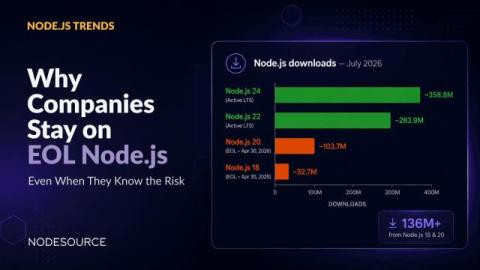
Legacy Node.js is rarely an awareness problem. It is a risk, cost, and uncertainty problem. Last week, we looked at a striking signal in the official Node.js download data in Node.js Downloads Surge in 2026 as Node.js 24 Takes the Lead. Node.js 24 had become the most downloaded Node.js release, a strong indication that modernization across the ecosystem is accelerating. But something else stood out.

Introducing DreamFactory 7.7.0

DreamFactory 7.7.0 is now the recommended stable release. It's a substantial one: AI agents become governed, human-owned API consumers; a new open-source API Builder lets you author custom REST endpoints without writing scripts; versioned Schema Contracts catch database drift before it reaches your consumers; and the platform baseline moves to Laravel 13.25 and PHP 8.3.

How to Build a Fee Transparency Compliance System for Multifamily Listings (While the Rules Are Still Settling)

A leasing team lowers the admin fee on a two-bedroom unit inside the PMS on Monday. By Friday, the property’s own site still shows the old figure, two syndication partners show a third number, and the Google Business Profile lists no mandatory fees at all. Every one of those surfaces is an advertisement. Under a growing set of state all-in-pricing laws, each one is supposed to display the same total monthly price. The regulation itself is readable in an afternoon.

Add resumable streaming and reliable tool calling to your OpenAI agent

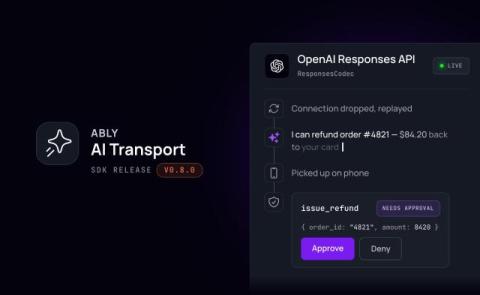
If you build an agent against OpenAI's Responses API then the simplest way to get output to the user is streaming over HTTP/SSE. If the user refreshes the page, loses connection, switches devices, or needs to approve a tool call, then there's nothing in the API to help you. AI Transport is Ably's session layer for agent-to-user conversations. An agent built on it gets resumable streams, multi-device sessions, and approval gates that wait for a human user, without deploying additional infrastructure.

The Evolution from Test Automation to Autonomous Testing

Testing looks nothing like it did five years ago. What once demanded armies of engineers writing brittle scripts now runs on intelligent systems that create, adapt, and analyze tests on their own. AI has rewritten the rules, and the teams that recognize this shift early are pulling ahead of those still patching broken automation night after night. For QA leaders and DevOps directors under pressure to ship faster without sacrificing quality, understanding this evolution is more than academic.

Auto-fix lint errors in CI: PRs that fix themselves

Count how many times you’ve proudly submitted a new PR only for CI to fail for the most mundane and annoying reasons: While these lint rules are useful and important to enforce, would it be possible to just…not have to deal with them? Enter auto-fixing CI, the concept of self-healing PRs and CI workflows, without any human (or agent) interaction: The key detail that enables all of this to work: modern linters can apply trivial and mechanical fixes to most lint violations.

Smarter, faster CI/CD for the new AI-powered development loop

Most AI coding tools run in a Linux container somewhere. Codespaces is Linux. Copilot’s coding agent works in an ephemeral, Actions-powered Linux environment. Nearly every agent framework assumes a container that spins up in seconds. None of them can build your iOS app, or have build cache to speed up the builds, or have simulators that can run tests that you can view.

Top Enterprise Software Development Firms for Oil and Gas

Oil and gas IT budgets in 2026 lean toward modernization, not headcount. Drilling data, old SCADA systems, legacy ERP - none of it talks to AI tools without real software work behind the scenes. Cybersecurity rules tightened across the EU and US this year, too. Internal teams rarely cover seismic interpretation, OT security and cloud migration all at once. That gap is why operators keep hiring specialized firms instead of growing every skill in-house.

A Starlette middleware guide for FastAPI and Python developers

Most web applications start clean with a handful of route handlers, each focused on a single business logic. As the app moves to production, the audit team wants every request logged, and the security team wants API key validation on all routes. As the app grows, we might introduce rate limiting, CORS for a new frontend, and a request ID for distributed tracing.