Systems | Development | Analytics | API | Testing

7 Key Benefits of Data Visualization Tools

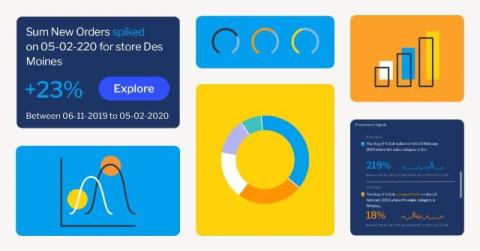
Data visualization is one of the most important capabilities of any business intelligence (BI) and analytics solution. It helps people translate complex data into a visual context, like a chart or a graph, identify trends numbers alone can't easily reveal, and discover hidden patterns in your dashboard. Data visualization also provides a wealth of additional benefits for data analysis, such as enabling easier understanding of the correlation between operations and results.

ICYMI: Databox's Biggest Update Yet | 2025 Keynote Highlights

In case you missed it… we just launched the glow-up your dashboards have been waiting for. You can now: Prepare your data for better analysis later Build any metric you need with multiple dimensions Drill down to row-level data Break down Databoards and metrics by specific dimensions Oh, and you can try all of the features for free.

EP 23 | From Poker Tables to Boardrooms: AI, Risk, and Business Communication with David Daneshgar

In high-stakes environments like professional poker and startup entrepreneurship, precision, timing, and strategy are everything. And nobody knows that better than David Daneshgar. In this episode of The AI Forecast, we’re joined by David Daneshgar, a World Series of Poker champion and now Co-founder and CEO of Whippy, a company using AI to transform how businesses communicate with their customers.

A Vision for the Future: Qlik's New Agentic AI Experience

The future of data and analytics will be nothing like the experience we're used to today. We are at the beginning of a transformation that will fundamentally reshape how businesses use data, make decisions, and create value. At the center of this revolution is Agentic AI. Agentic AI fundamentally changes the way we work with data – moving from passive, reactive AI systems to autonomous, goal-oriented agents capable of reasoning, planning, and executing complex tasks across diverse data landscapes.

From Harmony to Outcomes: Doing Data Differently at Qlik Connect

Qlik Connect this year started a little differently. Not with slides. Not with a video. But with a few minutes of unified harmony. On stage stood the Barcelona Guitar Quartet — except instead of four guitars, there was only one. And yet the sound that emerged was rich, layered, and astonishing. If you had closed your eyes, you’d have sworn it was a full band. It was a masterclass in collaboration.

Mastering Data Warehouse Modeling for 2025

Data is the new oil—but without a well-structured refinery, even the most abundant data becomes noise. Data warehouse modeling is that refinery: the critical blueprint that ensures organizations can store, retrieve, and analyze data with precision and efficiency. As of 2025, the landscape of data warehousing continues to evolve rapidly.

AI ETL Tools: Revolutionizing Data Engineering

In 2025, the integration of Artificial Intelligence (AI) into Extract, Transform, Load (ETL) processes is transforming the data engineering landscape. Traditional ETL workflows are evolving from rigid, manually scripted pipelines into intelligent, adaptable systems powered by AI. These AI-driven ETL tools enable companies to handle increasing data complexity, schema drift, and real-time transformation demands without massive engineering overhead.