Systems | Development | Analytics | API | Testing

How to Accelerate Vulnerability Remediation with AI

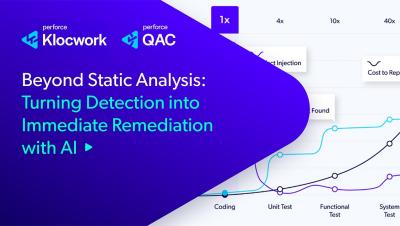
Perforce QAC and Klocwork's new AI-assisted code remediation capabilities combine deep static analysis with AI-guided fix recommendations, helping developers resolve issues faster while maintaining compliance, security, and code quality. In this webinar, you'll see a live demo of how teams can accelerate remediation, reduce rework, and enable flexible AI-powered workflows directly within their development environment.

What Is a CVE, and Why Should Every Node.js Developer Care?

If you've ever updated a dependency, scanned your project for vulnerabilities, or opened a GitHub Security Advisory, you've probably seen something like CVE-2025-13465. For many developers, it's just another identifier attached to a security warning. Easy to ignore, especially when your priority is simply getting your application shipped. But that small reference represents something much bigger: it's the common language the software industry uses to identify and communicate security vulnerabilities.

Product Threat Intelligence Providers 2026 Listed

Product threat intelligence tells payment device manufacturers and payment service providers (PSP) about the vulnerabilities and attack techniques that threaten the products they build or rely on to process payments. In 2026, the kind of specialist product threat intelligence provided by firms like PCA Cyber Security is getting much more critical for compliance and cyber resilience.

Security at Scale: How NodeSource Remediated 21 Vulnerabilities Across Enterprise Node.js Environments

Security vulnerabilities in production environments rarely arrive one at a time. Recently, one of our enterprise Node.js support customers identified a collection of security advisories affecting their Node.js infrastructure. The affected environments were running Node.js v20 and v22 and included vulnerabilities not only within runtime-adjacent tooling but also in components distributed alongside Node.js deployments.

CVE, CVSS, and the Mistake Most Teams Keep Making

Modern software systems are exposed to a constant stream of disclosed vulnerabilities. Thousands of new issues are published every year across operating systems, runtimes, libraries, and frameworks. Treating all of them as equally urgent is not realistic, and trying to do so often leads to ineffective security work. To manage this volume, the security community relies on two foundational mechanisms: CVE and CVSS.

Securing LLMs: Insights into OWASP Top 10 | Maryia Tuleika | TTTribeCast Webinar

AI can feel like a black box, but when it is tested like any other system, unexpected weaknesses begin to surface. This session explores how large language models can be pushed into unsafe or unintended behavior, revealing that AI is not immune to flaws, poor decisions, or broken assumptions.

What is Exposure Management? Explained for Vulnerability Management Teams

If you're a vulnerability management professional or have experience leading teams that do vulnerability management, you know CVEs inside and out. You've got your scanning tools configured, your patch cycles running, and your CVSS score thresholds set. But lately, something probably feels off. Maybe it's the fact that breaches keep happening despite all the patching. Maybe it's that your CVE count keeps growing faster than you can remediate. Or maybe you're just tired of explaining why that "critical" vulnerability in a disconnected test server isn't actually critical.

Simulating Multi-Agent Workflows to Find Hidden API Vulnerabilities

API gateways are often viewed as the centralized entry point for client HTTP requests in a distributed system. They act as intermediaries between clients and backend services, managing API request routing, load balancing, rate limiting, access control, and traffic shaping across multiple backend services. This API management is vital for many services and products, but many organizations can put too much stock in it.

What Is CVE? Common Vulnerabilities and Exposures Overview

Common Vulnerability and Exposures (CVE) collects known cybersecurity vulnerabilities and exposures to help you to better safeguard your embedded software. This framework is central to managing security threats effectively. Here, we explain what is CVE, unpack the role of CVE identifiers, examine the differences of CVE vs. CWE, expand on the CVE list, and outline how identifying vulnerabilities early in software development can be achieved with the right static analysis tools.

CVE Funding Disruption: How Security Teams Can Prepare

The longstanding Common Vulnerability and Exposure (CVE) database has vitally guided security teams for over 20 years, connecting cybersecurity experts, developers, vendors, and researchers in their shared ability to track unknown vulnerabilities in software. But in April of 2025, the MITRE CVE database program was in jeopardy. U.S. government funding for CVE, managed by MITRE and sponsored by CISA, was set to expire. Only in the 11th hour was funding secured, and the contract extended — for now.