Systems | Development | Analytics | API | Testing

Modern Software Development For Today's Systems & Applications

The latest News and Information on Software Testing and related technologies.


The Perforce Delphix DevOps Data Platform Explained in Under 3 Minutes
Software teams move fast — until they hit a data bottleneck. Meet the Delphix DevOps Data Platform from Perforce. Delphix automates the delivery of compliant, production-quality, and AI-ready data so teams can validate and release software at AI speed. With Delphix, you can: Provision and refresh virtual datasets in minutes, not days or weeks. Automatically discover and mask sensitive data while preserving relationships across systems.

Stop Chasing Ghosts: How AI Helps Solve Flaky Test Detection
Flaky tests not only slow your pipeline but also limit how fast your entire organization can move. Learn how AI is finally breaking through it.

Four signs your automation suite is costing you more than it's saving
An automation suite that’s losing ground rarely makes it obvious. Coverage numbers look reasonable. Tests are running. The CI pipeline is green more often than not. Meanwhile, the team is quietly working around what isn’t working – rerunning tests until they pass, deferring maintenance, or accepting a regression window that’s wider than it should be. Those workarounds can feel normal. They aren’t.
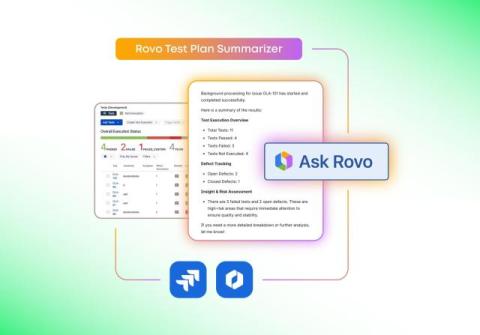
Get Faster Test Plan Insights in Jira with Xray's Rovo Test Plan Summarizer
Understanding the health of a Test Plan isn't always as straightforward as it sounds. A Test Plan may contain hundreds of Tests, multiple Test Executions, linked requirements, and defects spread across different areas of a project. The information teams need is usually there, but finding answers often means navigating through several screens, reviewing reports, and manually connecting the dots. Questions such as How much testing has been completed?, Are there any coverage gaps?

OctoPerf MCP Server, Fully On-Premise: AI Load Testing With a Local LLM
But a recurring question came from banks, hospitals, defense and public-sector teams: what if nothing is allowed to leave our network, not even the prompt? This article answers that question with a full walkthrough.. We will stand up a 100% on-premise, air-gapped stack, and it only takes two things to install: OctoPerf Enterprise in Docker, and a local Qwen3 large language model running in LM Studio, which doubles as the Model Context Protocol client.
Why your automated UI tests keep breaking
Automated test suites tend to follow the same arc. The suite works well until the application changes and a block of tests fails. Someone fixes them. The application changes again. At some point, the work of keeping tests current starts consuming the time that should go toward coverage decisions, risk assessment, and the testing work that requires human judgment.
Automated testing vs. autonomous testing
Autonomous testing is one of the most talked about developments in software quality right now. It shows up in analyst reports, vendor pitches, conference talks, and job descriptions – often in the same breath as automated testing. Most of those conversations treat the two as interchangeable, or worse, position autonomous testing as simply a smarter, more advanced version of what teams already do.

Build resilient end-to-end tests with AI agents in SmartBear Reflect | Demo Den
See how SmartBear Reflect uses agentic AI to build end-to-end tests in minutes and keep them resilient as your application changes. In under 20 minutes, Reflect co-creator, and SmartBear Director of Product Management, Todd McNeil walks through live test creation across web and mobile, with zero fluff.

Digital Twins for Devs & AI Agents - Record, Replay & Catch Regressions | Keploy
Give your developers — and your AI agents — a digital twin of your live environment. Keploy records real traffic from your live services (no production access, nothing to spin up) and replays it as a faithful twin, so you can continuously verify behavior and catch regressions before they ship. In this demo: record a live service, turn that traffic into integration tests and mocks automatically, replay everything against digital-twin sandboxes, and wire it into CI for continuous verification.