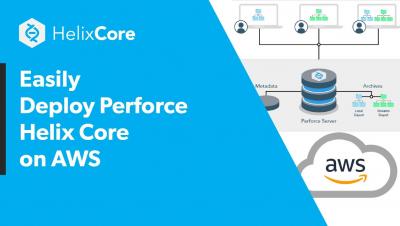
How To Deploy a Perforce Helix Core Server on AWS
This complete guide goes through all the steps of installing your own Helix Core server on AWS using the Enhanced Studio Pack cloud formation template.


CLI stands for command-line interface, a text-based interface you can use to input commands and perform various operations. If you’ve ever used the dart or flutter commands in your console, you’ve used a CLI. Sometimes, though, you may end up writing a CLI of your own.
As a senior Flutter developer, a big part of my daily job consists of reviewing code, mentoring other developers, and helping them with their problems. One mistake that I noticed developers repeating on many occasions is misusing BuildContext. I analyzed why this happens and came to the conclusion that it is because of an incomplete understanding of what BuildContext is, how it works, and its scope and lifecycle.
GitHub Actions is a powerful continuous integration and continuous delivery (CI/CD) platform that allows developers to automate build, test, and deployment pipelines. Workflows automatically build and test code whenever an event occurs, such as a pull request or a deployment of merged pull requests to production. Best of all, you can use it without leaving the comfort of your own repository!
The Ably Terraform provider greatly simplifies the provisioning and managing of realtime architectures that include Ably via HashiCorp Terraform. Our growing reliance on realtime applications is highlighted both by the impact of incidents such as WhatApp’s latest outage, and by an exponential growth in use cases for realtime technology. This growth is spurred on by the fast adoption of dynamically orchestrated, microservice-oriented cloud architectures.
Codemagic is now officially integrated with Runway, the DevOps platform for mobile. But wait, you might be wondering, isn’t Codemagic already that as a CI/CD for mobile? Aren’t the two services interchangeable? In fact, it’s quite the opposite — they’re powerfully complementary.
Realtime digital experiences are in high demand. They keep users engaged, informed, and entertained in a fast-paced digital world, and they allow businesses to better serve their customers, provide more efficient and effective services, and gain the upper hand over competitors. This is the second post in a series that looks at what it takes to build and deliver realtime experiences for end-users.