Systems | Development | Analytics | API | Testing

Instant Java Client SDK, no spec required!

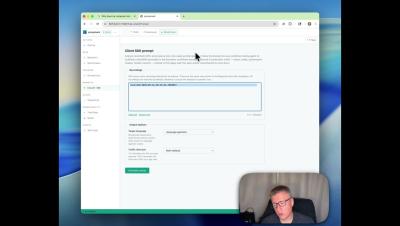
Learn how to generate a client SDK for a production service when you have no documentation, no OpenAPI spec, and no remaining team knowledge of the original Ruby code. This demo shows you how to capture real production data from a running app and transform it into a functional Java client library in minutes. Visit proxymock.io OR speedscale.com to learn more.


Tokens Per Watt Is the Real Limit on AI Revenue

Most AI revenue will flow through tokens — and the two bottlenecks are tokens per watt (energy cost) and tokens per second (throughput). Tokens per watt determines how much output you can generate from a fixed energy supply — already constrained and getting tighter. Tokens per second sets the ceiling on how fast that revenue can flow. Kong's AI Gateway optimizes both at the connectivity layer: semantic caching and semantic routing increase token output without adding watts or latency.#Shorts.

Escape the MAR-Tricks! Choose the red pill.

The very system designed to keep you comfortable is the same one keeping you trapped. You pay only for rows that change. Simple, right? But the reality is quite different. MAR mechanics are designed to blow up when you scale. You expect to be paying for real data changes but you end up paying for the whole row, regardless of how little data you move on it. It lures you in with simplicity but the underlying mechanics is an alternate reality. Every connection follows its own pricing curve, the costs stop behaving logically, and forecasting your bill turns into a nightmare.

Zscaler Revolutionizes Cybersecurity Data with Snowflake

Zscaler's Tiffany Blakeney shares how her team replaced fragmented tools and months-long development cycles with Snowflake's all-in-one AI platform. By consolidating all data, APIs, and AI models in one secure platform, Zscaler reduced campaign creation from months to minutes—and more importantly, gained the trustworthy, governed AI foundation a cybersecurity company demands. Learn how they're using Snowflake's integrated AI capabilities to move from POC to production faster than ever while maintaining the security posture critical to their industry.

qTest Manager Explained: Test Plans to Execution Reports in less than 3 minutes

Get a quick walkthrough of qTest Manager by Tricentis—the test management platform built for modern QA teams and developers. In this video, you'll see how qTest Manager is structured around four core components: Test Plan – Set up and organize your projects with timelines, releases, and version tracking Requirements – Manage and track requirements directly within your QA workflow Test Design – Build and organize your test case library.

Test Execution & Defect Reporting in qTest Manager | Full Walkthrough

See exactly how QA testers execute manual test cases and report defects directly from qTest Manager—all in one seamless workflow. In this demo walkthrough, you'll see: Test Execution View – Navigate test suites, review test run properties, and launch execution via TestPad Step-by-Step Execution – Walk through individual test steps, log actual results, and mark steps as Passed, Failed, Blocked, or Skipped in real time.

SmartBear at Atlassian Team '26: A Recap of What's New with AI and Rovo

What did Atlassian Team ’26 reveal about the future of software quality and AI-powered delivery? In this recap from the event floor inside the Anaheim Convention Center, SmartBear shares key themes from the event, including Atlassian Rovo, the Teamwork Graph, AI-driven workflows, and how QA teams are adapting to faster, AI-assisted software delivery inside Jira. See quick highlights from the event floor, SmartBear’s latest Zephyr innovations, and how conversational AI and quality intelligence are becoming part of the modern software delivery workflow.

Are Microservices Dying?

LLMs are absorbing the business logic of microservices for agentic use cases — but both patterns will coexist in enterprise infrastructure for a long time. Cloud-native infrastructure (microservices + APIs) keeps powering web and mobile experiences. The agentic layer — LLMs, MCP tool calls, and context traffic — runs in parallel, activating the same APIs and CRUD operations underneath. Kong manages both swim lanes: the API traffic between clients and microservices, and the context traffic flowing between agents and LLMs.#Shorts.

AlloyDB Lakehouse Federation: Unified access to BigQuery and Google Cloud Lakehouse

Join Paul Ramsey, Product Manager at Google, for a demonstration of AlloyDB’s new Lakehouse Federation capability. Using a fictional financial services firm, Cymbal Investments, we show how analysts can research S&P 500 trends by combining real-time vector search with data in BigQuery and Google Cloud Lakehouse. In this video, you will see: Learn how AlloyDB enables cloud and AI transformation for your data platform.

How to Scale Paid Media Across 5 Channels Without Losing Visibility (Google, Meta, LinkedIn, TikTok)

Agencies hit the same wall every time they try to grow: who is going to actually run the campaigns, and how do you keep visibility across every client and every channel when you do? Ashish Chaturvedi, data analyst of Atidiv, walks through how Atidiv and Databox solve both sides of the problem. Atidiv handles campaign execution across Google Ads, Meta, LinkedIn, TikTok, and email. Databox gives you the visibility layer: one interactive view where you can see spend, revenue, and return across every channel without chasing updates in Slack, email, or spreadsheets.