Should You Use Page Objects?
Learn about when to use page objects for better UI automation, and how to implement a good page object pattern.


The latest News and Information on Software Testing and related technologies.
Learn about when to use page objects for better UI automation, and how to implement a good page object pattern.
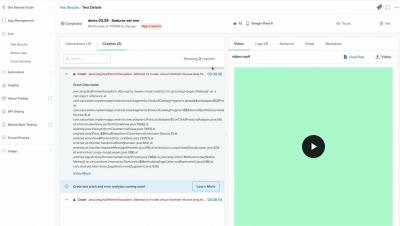
Real Device Cloud error and crash reporting can help you find the root cause of errors faster and inspire greater confidence in your mobile app’s performance.
Caris Life Sciences® (Caris) is a leader in precision medicine. Their molecular profiling tests help Oncologists diagnose and treat their cancer patients. Caris is also deep in clinical research, supporting the development of tomorrow's treatments. With more than 1,300 employees, Caris has offices in the United States, Japan and Switzerland and provides services throughout the U.S., Europe, Asia and other international markets.
Automated tests are the cornerstone of high-quality software. Development teams can move faster without worrying about breaking existing functionality when automated tests run with each commit or deployment. At the same time, automated tests can help expand test coverage to provide customers with a higher-quality product. Selenium is one of the most popular tools for testing web applications.
These open source frameworks offer a range of features and capabilities that make it easier for developers to automate their web applications.
This is Part 3 of the Requirement Gathering Blog series by Rahul Parwal where we explore more on Exploring Requirements. We’d like to thank him for sharing his expertise with the community through this information-packed piece. Check out the blog on Requirements in The Agile World for Part 2 of this series.
Test management is an important aspect of software testing. Tools for test management are used to organize testing activities, report the progress of QA activities and maintain information on how testing is done. Test management tools in software testing help teams create and manage their test cases by providing the right features and functionalities. There are both proprietary and open-source test management tools available. Each tool has its pros and cons.
The Katalon Platform is continuously evolving to provide the best user experience and to help quality engineers streamline their processes. This release introduces significant enhancements to its Atlassian Jira integration and defect reporting, making it easier for QA managers, quality engineers, and developers to collaborate effectively.