Systems | Development | Analytics | API | Testing

Serverless Decoded: Reinventing Kafka Scaling with Elastic CKUs

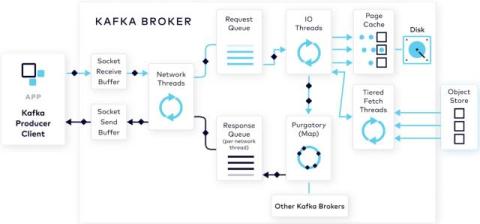
Apache Kafka has become the de facto standard for data streaming, used by organizations everywhere to anchor event-driven architectures and power mission-critical real-time applications. However, this rise has also sparked discussions on improving Kafka operations and cost-efficiency—streaming data is naturally prone to bursts and often unpredictable, resulting in inevitable variations in workloads and demand on your Kafka cluster(s).

7 Crucial Data Governance Best Practices To Implement

Data governance covers processes, roles, policies, standards, and metrics that help an organization achieve its goals by ensuring the effective and efficient use of information. It sets up the processes and responsibilities necessary to maintain the data’s quality and security across the business. Data governance manages the formal data assets of an organization.

Snowflake Expands Partnership with Microsoft to Improve Interoperability Through Apache Iceberg

Today we’re excited to announce an expansion of our partnership with Microsoft to deliver a seamless and efficient interoperability experience between Snowflake and Microsoft Fabric OneLake, in preview later this year. This will enable our joint customers to experience bidirectional data access between Snowflake and Microsoft Fabric, with a single copy of data with OneLake in Fabric.

Top 3 Benefits of Automated Analytics

Imagine transforming raw business data into actionable insights with minimal effort. This is the value proposition of automated analytics, a form of data analytics fast becoming more accessible among modern business intelligence (BI) and analytics software solution vendors. Independent software vendors (ISVs) and enterprise organizations at the cusp of investing in analytics struggle with manual data processes that are time-consuming and prone to errors.

Fast-Track to Data Insights: Deliver Impactful Salesforce Sales Metrics to the Databricks Gold Layer

Join Kelly Kohlleffel from Fivetran in this demonstration that moves and transforms raw Salesforce data into impactful sales metrics in the Databricks Data Intelligence Platform. Learn how to set up a Salesforce to Databricks connector with Fivetran’s fully automated and fully managed data movement platform. Then watch how the new dataset in Databricks is automatically transformed from the Databricks bronze layer to the gold layer—making it analytics-ready and data product-ready in minutes.

Streamlined Data Movement: Fivetran's SAP ERP Integration with Databricks Explained

Join Kelly Kohlleffel from Fivetran as he demonstrates the seamless integration of SAP ERP data into the Databricks Data Intelligence Platform using Fivetran’s powerful data movement automation capabilities. Learn how the Fivetran SAP ERP for HANA connector effortlessly syncs your data to Databricks, making it ready for all data workloads. Discover how Fivetran utilizes Databricks’ features like Serverless and Unity Catalog to help you quickly build new data products and solutions with SAP ERP data efficiently in Databricks.

Introducing Confluent Cloud OpenSearch Sink Connector

Amazon OpenSearch is a popular fully managed analytics engine that makes it easier for customers to do interactive log analytics, real-time application monitoring, and semantic and keyword searches. It can also be used as a vector engine that helps organizations build and augment GenAI applications without managing infrastructure (we’ll talk about this in future blogs). Additionally, the service provides a reliable, scalable infrastructure designed to handle massive data volumes.

The Rise of AI in FP&A: How insightsoftware Empowers Your Team

Despite the transformative potential of AI, many financial planning and analysis (FP&A) teams are hesitating, waiting for this emerging technology to mature before investing. According to a recent Gartner report, a staggering 61% of finance organizations haven’t yet adopted AI. Finance has always been considered risk averse, so it is perhaps unsurprising to see that AI adoption in finance significantly lags other departments.

LLM Validation and Evaluation

LLM evaluation is the process of assessing the performance and capabilities of LLMs. This helps determine how well the model understands and generates language, ensuring that it meets the specific needs of applications. There are multiple ways to perform LLM evaluation, each with different advantages. In this blog post, we explain the role of LLM evaluation in AI lifecycles and the different types of LLM evaluation methods. In the end, we show a demo of a chatbot that was developed with crowdsourcing.