Systems | Development | Analytics | API | Testing

How custom AI agents via MCP extend autonomous QA

Custom AI agents via MCP (Model Context Protocol) let an autonomous QA system reach beyond its built-in skills by connecting to external tools such as GitHub and browser automation services. In practice, that means a QA agent can inspect source code changes, identify new features, compare them against existing test coverage, and create missing test cases automatically. For teams managing growing test suites, this turns AI from a closed assistant into a connected workflow engine.

WebSocket reconnection in AI agents: transport recovery vs. session recovery

Your AI agent is mid-task, waiting on the result of a search tool call it made 30 seconds ago. The user is watching a spinner. Then a network blip drops the connection. The application reconnects in under a second, fast enough that most monitoring wouldn't flag it. But the tool call result that came back during the gap is gone, and so are the 200 tokens the agent generated before the silence began. The reconnect succeeded - but the session didn't.

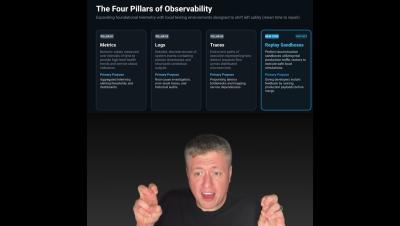
How We Designed a Node.js Production Debugging Experience with AI

Earlier this year, our team launched the N|Solid Extension, a Node.js production debugging and observability tool designed for modern development environments. The goal was simple: help developers investigate production issues without constantly switching between dashboards, monitoring platforms, and their editor. Instead, runtime telemetry, diagnostics, security insights, and AI-assisted workflows could live directly where developers already spend most of their time.

How is Agentic AI rewriting Retail Banking?

Your customers are no longer comparing you to the bank down the street. They are comparing you to Amazon, Netflix, and every hyper-personalized digital experience they interact with daily. And most banks are losing that comparison. Quite literally! Somewhere between the legacy core systems, the compliance overhead, and the quarterly earnings pressure, a tectonic shift has started. Agentic AI is no longer a concept in a research paper.

Inside NERSC at Berkeley Lab: How a DOE Office of Science User Facility Is Exploring ClearML for Scientific AI Workflows

NERSC, the mission high-performance computing center for the U.S. Department of Energy Office of Science, is using ClearML as part of the AI infrastructure stack for Perlmutter, the upcoming Doudna supercomputer, and the broader American Science Cloud. Here is a look at what they are exploring and why it matters for AI for science at scale.

Generative AI for QA: How SDET Workflows and Skills Are Changing

Generative AI for QA is the use of large language models to accelerate the creation and analysis of testing artifacts — drafting test cases, summarizing requirements, and generating synthetic test data. AI agents extend that capability into multi-step autonomous workflows that plan, delegate, and execute testing tasks across an entire delivery pipeline. For SDETs, the shift is not about learning to prompt more cleverly.

Human in the Loop Testing: Where AI Ends and QA Judgment Begins

The question isn't whether to use AI in QA. It's knowing exactly where to keep a human in control. The core risk: Over 75% of multi-agent failures are silent semantic errors that pass automated checks but violate business logic — detectable only by human inspection (Cemri, Pan et al., NeurIPS 2025). The division of labor: AI owns repetitive generation and execution; humans own risk analysis, requirement interpretation, exploratory investigation, and final sign-off. The operational discipline.

How Agentic AI is Rewriting the Rules of Global Trade

Explore how a global supply chain company turned its data platform into a customer-facing product designed to operate at the speed of disruption. Boris Rabkin, Chief Information Officer at Ligentia, shares how the company executed that shift through a deliberate phased approach and a partnership with ThoughtSpot. He breaks down how to build a data foundation that scales, what it takes to embed analytics where decisions happen, and how to structure AI ownership and governance across a global regulatory environment.